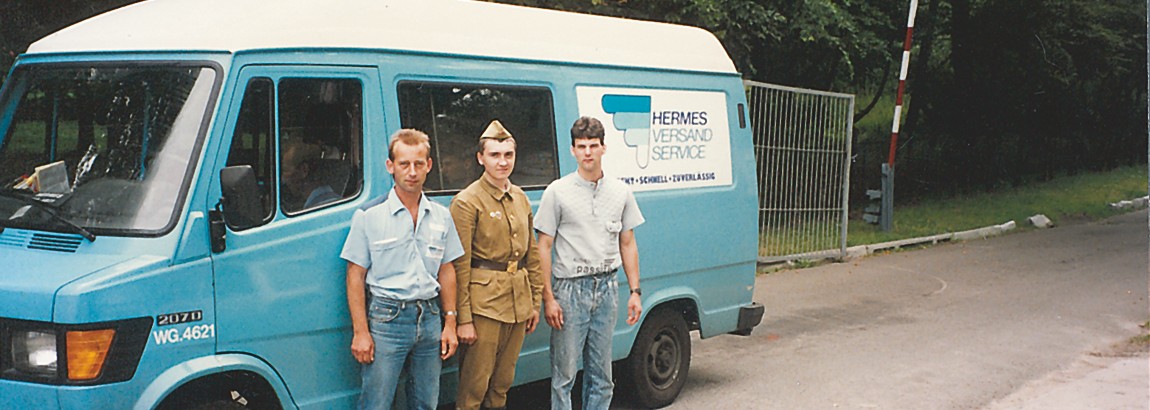
Hermes in the 90s
1990
Hermes in the new Bundesländer
In the wake of the currency reform that took effect on July 1, Hermes extends its home delivery service to East Germany. This is made possible with the opening of seven new depots all of which opened on the same day. Given the uncertain legal situation, Hermes Versand Service Berlin GmbH is founded on July 1 under East German law. A provisional office in Coburg provides temporary support for the new depots. Following reunification, the network is expanded by a further five new depots. Unlike its depots in the west of the country, here Hermes is partially working with cooperation partners.
1991
IT enhances the flow of information
Following the equipment of the depots with PCs, HVS introduces data transfer processes to head office.
1992
Cell coding
Just 20 years after being founded, Hermes delivers its 500 millionth parcel. Of a total of 64 depots, 48 are in the old Bundesländer, 16 in the new. In order to optimise tour planning, together with the Infas Institute, Hermes develops its own cell coding (refined postcodes) for the old Bundesländer.
1993
Testing alternative drive systems: Hermes begins trials with electric vehicles
As part of its efforts to test alternative drive systems, HVS purchases three electric test vehicles developed in collaboration with Daimler Benz. However, their performance is not yet sufficient to meet the demands of a fleet making roughly 100 drops per tour.
1994
The beginning of a new era in IT
Autumn saw the first depots equipped with stationary scanners to capture parcels (using a barcode on the label). This makes it possible to track and trace parcels from dispatch at the client’s premises to delivery at the customer’s doorstep. At the same time, computer-aided tour planning was introduced with generated manifests and receipts.
1995
Introduction of New Technologies, Services and Vehicles
Following the introduction of the shipment information system, SISY, at the depots, data transfer processes were established, which led to a reduction in lost parcels. This year, 3,940 employees processed 73.4 million parcels and generated revenues totalling DM360 million. Across the year, 2,800 vehicles drove 600,000 tours clocking up nearly 100 million kilometres. With five natural gas-dedicated vehicles, the company starts testing alternative drive configurations. In the middle of the year, the Darmstadt depot starts testing a new courier system, the Hermes Boten System. As part of the system, small parcels are no longer to be delivered by Hermes drivers, but by contracted couriers. In autumn, an evening service was launched for the Otto Group with deliveries made after 5.00 pm.
1996
New clients for Hermes
Following the introduction of the Hermes Boten Service, several Otto Group companies become new clients. These include Bon Prix, 3 Pagen, Witt, Rainbow, Sport Scheck and Alba Moda, who are integrated into the Hermes system by mid-year.
1997
Contract with the Deutsche Bahn AG / 25 years’ success
In a contract with Deutsche Bahn, Hermes now delivers rail passengers’ luggage door-to-door. Passengers hand over their luggage at their doorstep and it is ready and waiting for them when they arrive at their destination. With the introduction of the Hermes Privat Service, Hermes is now address private customers directly for the first time. In November, Hermes delivers its one billionth parcel. To celebrate its 25th jubilee, HVS can be truly proud of its achievements: at the end of the year, the company had processed over 100 million shipments. Sixty-four depots covering 118,000 square metres, 4,300 employees and just on 5,000 couriers and roughly 2,800 vehicles have contributed to this success.
1998
Expansion into New Markets and Acquisition of New Clients
In the light of the new legislation governing the postal service, Hermes expands its activities in delivering catalogues and bulk mail as well as letters of more than 200g. In autumn, the Baur mail-order company from Burgkunstadt is also integrated in the Hermes system. Revenues rise to DM530 million. The workforce comprises 3,350 Hermes employees, 2,000 sub-contractors/cooperation partners and 5,000 part-time couriers.
1999
Launch of the Hermes ParcelShop system (February 1)
By the end of the year, over 1,000 ParcelShops are installed across Germany at retailers’ and commercial operators’. These partners are largely deployed to process returns. In Hamburg, the head office and the depot are certified in line with ISO 14001 environmental standards.